How Commercial Soft Washing Works: Keeping Buildings Clean
When a building starts showing dark streaks across its siding, green patches creeping along the roofline, or a general graying of what used to be bright surfaces, most people assume it just needs a good blast of water. The instinct makes sense, but the reality of what is actually happening at a microscopic level tells a more interesting story, and a more important one. At Sunny Pressure Washing, we have built our commercial cleaning services around understanding that story, because treating the symptom without understanding the cause is how buildings end up damaged and business owners end up frustrated.
Commercial soft washing is not simply “pressure washing but gentler.” It is a fundamentally different approach grounded in chemistry and biology, one that addresses the root cause of surface contamination rather than temporarily removing its appearance. Understanding the science behind it helps explain why more commercial property owners are making the switch, and why the results tend to last dramatically longer.
What Is Actually Growing on Your Building?
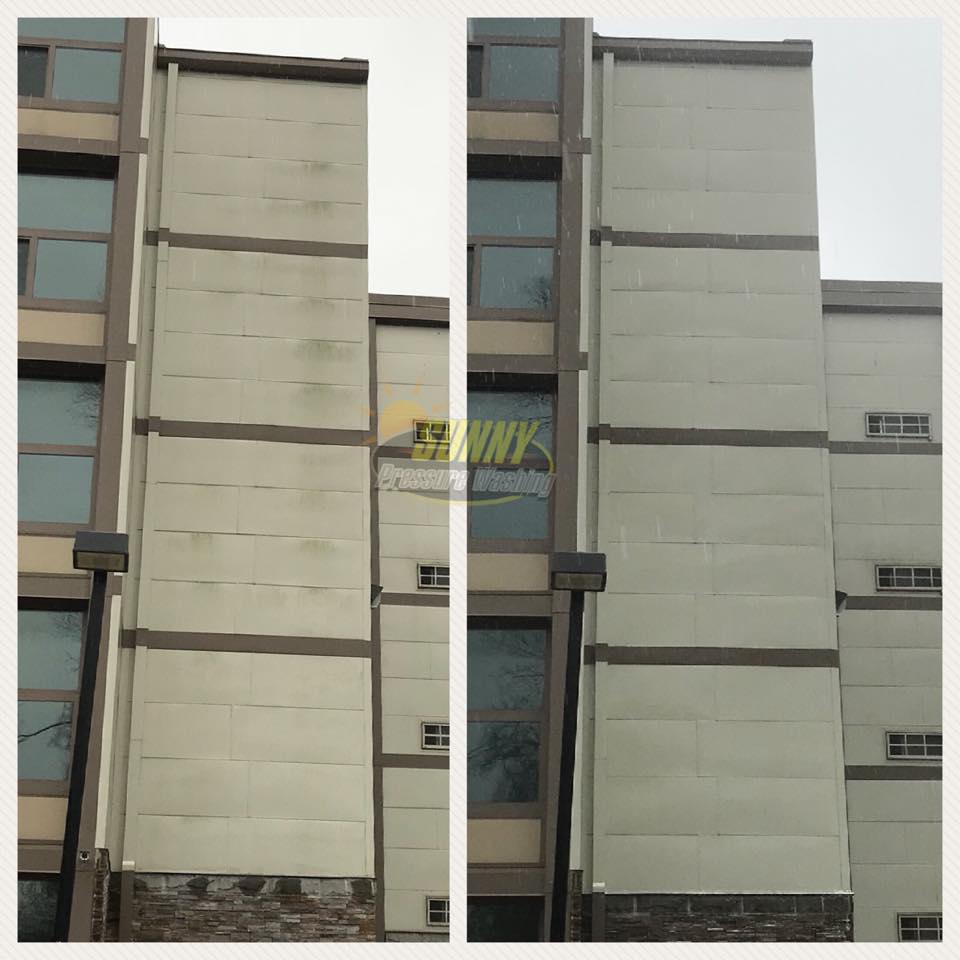
The dark streaks you see on commercial roofing, stucco, and painted siding are not simply dirt or oxidation. In the vast majority of cases, those discolorations are living organisms. Gloeocapsa magma, a type of cyanobacteria, is responsible for the black and gray streaking that appears on rooftops across the country. Algae, mold, mildew, and lichen are the culprits behind green, brown, and white patches on walls and facades. These organisms do not just sit on the surface, they colonize it, sending biological material into pores, cracks, and joints where water alone cannot reach them.
A study published in the International Biodeterioration and Biodegradation journal found that biofilm formation on building surfaces can begin within weeks of initial contamination and that untreated colonies accelerate surface degradation by trapping moisture and producing organic acids that break down substrates over time. In other words, what looks like a cosmetic problem is often an active, ongoing threat to the structural integrity of the material underneath.
The Chemistry That Makes Soft Washing Work
Soft washing relies on a carefully calibrated solution applied at low pressure, typically around 60 to 500 PSI compared to the 1,500 to 3,000 PSI common in standard pressure washing. The solution contains three primary components working in concert.
Sodium Hypochlorite
Sodium hypochlorite is the active biocidal agent in most professional soft washing formulations. At the right concentration, it penetrates the cell walls of bacteria, algae, and mold, disrupting cellular respiration and causing cellular death at the biological source. This is not surface-level cleaning. The chemistry reaches into the substrate to eliminate the organisms that water pressure would simply dislodge and redistribute.
Surfactants
Surfactants serve as the bridge between the cleaning solution and the contaminated surface. They reduce the surface tension of the water, allowing the solution to spread evenly and cling to vertical surfaces long enough for the biocidal chemistry to do its work. Without surfactants, the solution would simply run off before meaningful dwell time could occur.
Neutralizing Agents and Water
Professional formulations are balanced with agents that help manage pH and protect surrounding plant life, landscaping, and non-target surfaces. This is a critical point of differentiation between DIY attempts and professional applications. The ratio of these components matters enormously, and getting it wrong can damage vegetation, corrode metal fixtures, or leave residue that attracts future contamination faster.
Why Low Pressure Is a Feature, Not a Limitation
There is a common misconception that more pressure means better cleaning. For hard, sealed surfaces like concrete driveways, higher pressure has its place. For porous or coated surfaces like EIFS stucco, wood, painted metal, and asphalt shingles, high pressure is genuinely destructive. It can strip granules from shingles, force water behind cladding systems, and blast away the protective coatings that manufacturers build into their products.
The Asphalt Roofing Manufacturers Association has long recommended against high-pressure cleaning for asphalt shingle roofs precisely because the granule loss it causes accelerates UV degradation and shortens roof lifespan. Soft washing achieves full biological elimination without any of that mechanical damage, which is why many roofing manufacturers include low-pressure washing recommendations in their warranty guidelines.
Residual Protection: The Benefit That Outlasts the Day
One of the most scientifically significant advantages of commercial soft washing is what happens after the cleaning crew leaves. Because the biocidal agents eliminate organisms at the cellular level rather than physically removing visible growth, treated surfaces tend to stay cleaner longer. Studies tracking treated versus untreated surfaces have found that professionally soft-washed surfaces show significantly slower recolonization rates, often remaining cleaner for two to three times longer than surfaces cleaned with water alone.
This residual effect comes from the continued presence of treatment chemistry in the pores and microstructure of the surface material. Spores and bacteria that settle on a recently treated surface encounter an inhospitable environment and fail to establish new colonies, which is exactly what you want when protecting a commercial property that represents a significant ongoing investment.
A Process Worth Understanding
The science behind commercial soft washing is not complicated once it is laid out, but it is specific, and specificity matters. The right chemistry, the right dilution, the right dwell time, and the right application pressure are what separate a result that lasts from one that fades in a season. For commercial property owners, that distinction has direct financial consequences in maintenance costs, material longevity, and the impression the building makes on every client and tenant who walks through the door.
If your commercial property is showing signs of biological buildup or you simply want to stay ahead of it, the team at Sunny Pressure Washing is ready to help. Reach out to us today to schedule a consultation or get a free estimate, and we will walk you through exactly what your building needs and why.